

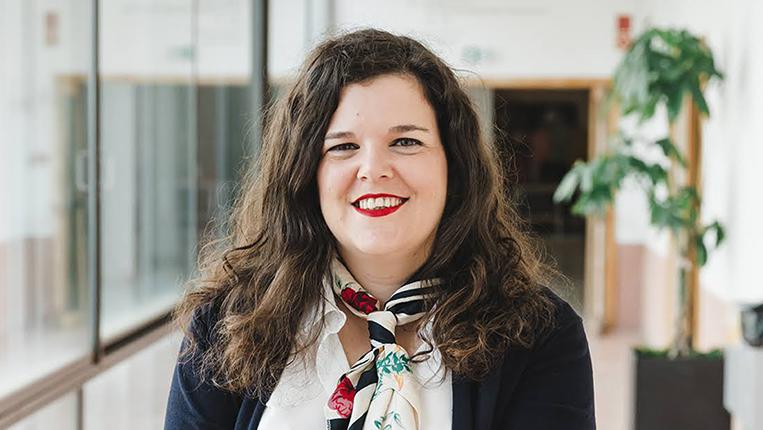

How can school leaders promote teachers’ wellbeing? It was in pursuit of this question that Monika Šimkutė-Bukantė, a PhD candidate at the Institute of Educational Research, Education Academy, Vytautas Magnus University (Lithuania), chose the Faculty of Education and Psychology of the Universidade Católica Portuguesa (FEP-UCP) for a doctoral internship. This mobility experience strengthened the international cooperation between the two partner institutions and fostered scientific exchange in Porto.
Monika research focuses on the relationship between school administration leadership and teachers’ professional well-being. Using a mixed-methods design, the study combines quantitative and qualitative perspectives to gain a deeper understanding of how school leaders can create supportive and rewarding professional environments.
An enriching external perspective on research
During her stay at FEP-UCP, the researcher worked on the analysis and interpretation of empirical data and on further developing the empirical part. She also presented the progress of her research in an open session attended by academic staff, researchers, doctoral students, and international guests.
Presenting and discussing the project outside her usual academic context proved to be a particularly valuable experience. “One of the most valuable experiences was having the opportunity to look at my own research through the questions of other researchers. The mixed-methods design of my study generated particular interest and discussion, encouraging me to explain and reflect more deeply on how the different stages of the research complement each other,” Monika explains.
Synergies, new ideas and the value of mobility
Monika chose FEP-UCP because of its interdisciplinary profile, which brings together expertise in Education and Psychology. This combination was particularly relevant for research situated at the intersection of educational leadership, organisational processes, and professional well-being.
However, her time in Porto also sparked some unexpected reflections. Through conversations with researchers from FEP-UCP and the Research Centre for Human Development (CEDH), discussions about their respective academic journeys took on a new dimension. “We began comparing the expectations, requirements and experiences of PhD students in Lithuania and Portugal. This naturally led us to consider well-being not only in the context of teachers, which is central to my dissertation, but also in the context of doctoral researchers themselves,” she shares.
This informal exchange revealed shared questions and research interests, opening up potential avenues for future collaboration, something Monika considers one of the most valuable outcomes of the internship.
A strong advocate of international mobility, the researcher highlights the importance of stepping outside familiar academic environments: “I think international mobility is particularly important during doctoral studies because we spend several years immersed in one research topic and often within the same academic environment. Stepping outside that environment helps us look at our research from a different perspective and question assumptions that may have become self-evident to us.”
Life in Porto
Beyond its academic dimension, living in Porto contributed significantly to making the mobility experience meaningful on both a personal and cultural level. Her stay in the city gave Monika the opportunity to experience Portuguese culture and everyday life beyond the university, complementing her academic work in a balanced and enriching way.
“I came to Porto with specific research objectives, but I am leaving with new questions, new connections and ideas for future collaboration. Academic mobility is valuable not only because of what we plan to achieve, but also because of the conversations and ideas that cannot be planned in advance,” reflects the researcher.
Now back in Lithuania and entering the final phase of her dissertation, the doctoral researcher looks back very positively on her time in Porto.
“I would especially like to thank Professor Patrícia Oliveira-Silva and Professor Luísa Mota Ribeiro for such a warm welcome, for making me feel genuinely expected and included, for their advice, and for giving me the space and encouragement to grow academically,” she concludes.